
El Niño, Rising Temperatures and Electricity Bills: Why Rooftop Solar Makes Sense for Indian Homes
By Rengy Team
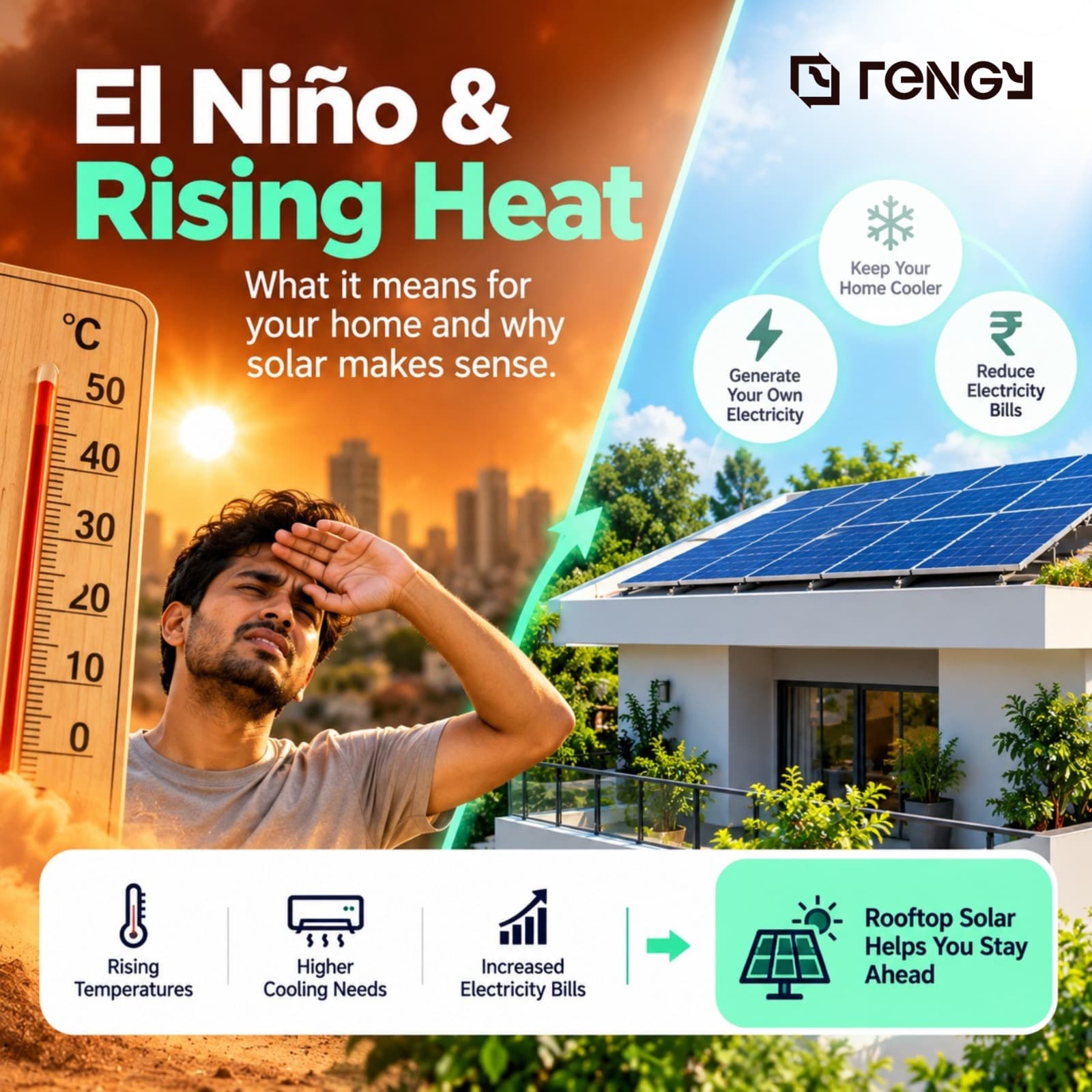
What If Your Next Summer Electricity Bill Is Higher Than Expected?
Imagine a typical Indian summer.
The temperature rises. Your fans run longer. Air conditioners work harder. Refrigerators consume electricity throughout the day.
And when the electricity bill arrives, you notice something familiar.
Your electricity consumption has increased.
Now add another factor to the conversation: El Niño.
El Niño is a climate phenomenon that can influence temperatures, rainfall patterns and weather conditions around the world, including India.
But what does El Niño mean for your home, your electricity consumption and your decision to install solar?
Let's understand.
1. What Is El Niño, and Why Does It Matter?
El Niño is a natural climate phenomenon associated with unusually warm sea-surface temperatures in the central and eastern equatorial Pacific Ocean.
It is one phase of the larger El Niño–Southern Oscillation (ENSO) climate cycle.
Although El Niño develops over the Pacific Ocean, its effects can influence weather patterns across different regions of the world.
In India, El Niño has historically been associated with an increased likelihood of weaker southwest monsoon rainfall, although the relationship is not consistent every year.
It can also influence temperature and atmospheric conditions.
However, El Niño does not automatically mean that every Indian city will experience extreme heat. Local weather, regional climate conditions and other atmospheric factors also play important roles.
The bigger concern for homeowners is what happens when unusually hot conditions increase the need for cooling.
2. How Rising Temperatures Can Increase Electricity Consumption
During hot weather, households often depend more heavily on electrical appliances.
Air conditioners may operate for longer hours. Fans may run throughout the day and night. Refrigerators may need to work harder to maintain their internal temperatures.
Consider a simple example.
Suppose a household runs a 1.5 kW air conditioner for an additional three hours each day.
That could mean:
1.5 kW × 3 hours × 30 days = 135 additional units of electricity per month.
This is only an illustrative calculation. Actual AC consumption varies depending on inverter technology, temperature settings, cooling load, efficiency and operating conditions.
Still, it demonstrates how longer cooling hours can increase monthly electricity consumption.
And when consumption increases, the electricity bill can increase too.
The Summer Electricity Challenge
For many homeowners, the challenge is not just the electricity tariff.
It is the combination of:
- Longer appliance operating hours
- Increased cooling requirements
- Higher monthly electricity consumption
- Possible changes in electricity tariffs and billing charges
This is why it makes sense to think about energy planning before peak summer arrives.
3. Can Solar Help During Hot Summers?
Yes. Rooftop solar can help suitable households reduce the amount of electricity they purchase from the grid.
Solar panels generate electricity when sunlight reaches their photovoltaic cells.
During sunny daytime hours, a rooftop solar system can produce electricity that may help meet part of a home's electrical demand.
This is particularly useful for households that consume significant electricity during the day.
For example, daytime solar generation may help offset electricity used by:
- Air conditioners
- Fans
- Refrigerators
- Water pumps
- Computers and home-office equipment
- Other household appliances
The actual contribution depends on system capacity, solar generation, household demand and the applicable grid arrangement.
The important point is that solar allows your rooftop to contribute to your home's electricity needs.
4. Does Extreme Heat Mean Solar Panels Generate More Electricity?
This is one of the biggest misconceptions about solar.
More heat does not necessarily mean more solar electricity.
Solar panels need sunlight to generate electricity, but high panel temperatures can reduce their operating efficiency.
Solar generation depends on several factors, including sunlight intensity, panel temperature, shading, orientation, system design and equipment performance.
That means a bright, moderately warm day can sometimes be more favourable for solar panel efficiency than an extremely hot day with otherwise similar sunlight.
This is why professional system design matters.
At Rengy, technologies such as rooftop analysis, shadow analysis, heat maps and optimised solar layouts help make the planning process more informed.
The goal is not simply to install the maximum number of panels.
It is to design a system that suits the rooftop and the homeowner's energy requirements.
5. Why Should Indian Homeowners Consider Rooftop Solar?
1. Reduce Dependence on Grid Electricity
A properly designed rooftop solar system can generate part of your household's electricity requirements.
This can reduce the amount of electricity purchased from the grid.
2. Manage Long-Term Electricity Expenses
Solar provides an opportunity to generate electricity from an asset installed on your own property.
Although savings depend on the system, electricity consumption and applicable tariffs, rooftop solar can help households manage long-term energy expenses.
3. Make Better Use of Your Rooftop
An unused rooftop can become an electricity-generating asset.
Rather than leaving suitable rooftop space idle, homeowners can explore its potential for solar generation.
4. Support Cleaner Energy
Solar power generates electricity without direct fuel combustion during operation.
By using solar electricity, households can reduce their reliance on conventional grid-supplied electricity.
5. Prepare for Changing Energy Needs
Electricity consumption can change over time.
A household may add air conditioners, work-from-home equipment or other appliances.
Solar planning encourages homeowners to evaluate their current consumption and consider future electricity requirements.
6. How Much Solar Does Your Home Need?
There is no single solar system size that works for every household.
A family using 200 units per month may have different requirements from a family using 500 or 800 units.
The appropriate capacity depends on electricity consumption, available rooftop area, shading, system performance and local regulations.
Here is a simplified illustration of solar generation.
| Solar system size | Illustrative monthly generation |
|---|---|
| 1 kW | 100–150 units |
| 2 kW | 200–300 units |
| 3 kW | 300–450 units |
| 5 kW | 500–750 units |
These are broad planning estimates, not guaranteed output. Actual generation varies by location, season, weather, shading, design and system losses.
For example, a household using around 350 units per month might explore a 3 kW system as an initial planning option.
However, a proper rooftop assessment is necessary before finalising the capacity.
7. How to Go Solar Before Summer
If you're considering rooftop solar, here is a practical step-by-step approach.
Step 1: Understand Your Electricity Consumption
Review your electricity bills from the past 6–12 months.
Pay special attention to consumption during summer, when cooling requirements may increase.
Step 2: Check Your Rooftop
Assess the available rooftop space, roof condition, orientation and shading.
Nearby buildings, trees and other structures can affect solar generation.
Step 3: Choose the Right Solar Capacity
Select a system based on your consumption and rooftop suitability rather than choosing only by price.
Step 4: Understand Your Financing and Subsidy Options
Eligible residential consumers may be able to access financial assistance under the PM Surya Ghar: Muft Bijli Yojana.
Under the central subsidy structure, eligible residential rooftop solar installations can receive support of up to ₹78,000, subject to scheme conditions.
Loan and financing options may also be available, depending on the lender and applicant eligibility.
Step 5: Complete Installation and Grid-Connection Requirements
Work with an appropriate solar installation provider and complete the applicable DISCOM approvals, inspections and metering procedures.
Step 6: Monitor Your Solar System
After installation, monitor generation and system performance.
Regular inspection and maintenance help identify issues that could affect output.
8. How Rengy Makes the Solar Journey Simpler
Going solar should not mean making decisions without understanding your rooftop, electricity consumption or system design.
At Rengy, we believe homeowners deserve a smarter approach.
As an AI-powered solar platform, Rengy brings together technology, design and execution support to make residential solar easier to understand.
Our platform capabilities include:
AR Rooftop Preview: Visualise how solar panels could appear on your rooftop.
Instant 3D Solar Design: Explore a proposed solar layout before installation.
Shadow Analysis: Understand how nearby objects and shadows can influence panel placement.
Heat Maps and Optimised Layouts: Support informed rooftop planning and panel arrangement.
Execution and Monitoring Support: Connect the planning stage with installation coordination and ongoing system visibility.
The objective is simple:
Help homeowners move from solar curiosity to informed solar decisions.
9. Should You Wait Until Summer to Install Solar?
Not necessarily.
Solar installation involves more than mounting panels on a roof.
A typical project may include rooftop assessment, system design, quotation, financing decisions, documentation, DISCOM approvals, installation and commissioning.
These activities take time.
Starting the process before peak summer gives homeowners more opportunity to evaluate options and prepare.
It also helps avoid making rushed decisions when electricity consumption is already high.
The right time to explore solar is when you have enough information to make a sound investment decision.
Conclusion: You Cannot Control the Weather, But You Can Plan Your Energy Future
El Niño reminds us that weather patterns can change.
Hotter conditions can increase cooling demand, and increased electricity consumption can put additional pressure on household budgets.
But homeowners have more options today than simply relying on electricity supplied through the grid.
For suitable homes, rooftop solar can help reduce grid electricity purchases, improve long-term energy planning and make better use of available rooftop space.
You cannot control how hot the next summer will be. But you can start planning how your home uses electricity.
At Rengy, we're making that journey smarter, simpler and more accessible.
Is Your Rooftop Ready for Solar?
Explore your home's solar potential with Rengy.
Visit rengy.in
RENGY — Solar Made Simple.
Want to Know the Exact Cost for Your Home?
Get a free, personalized solar design and quote based on your rooftop and electricity usage.